Tuesday, 14 October 2014

The Apprentice

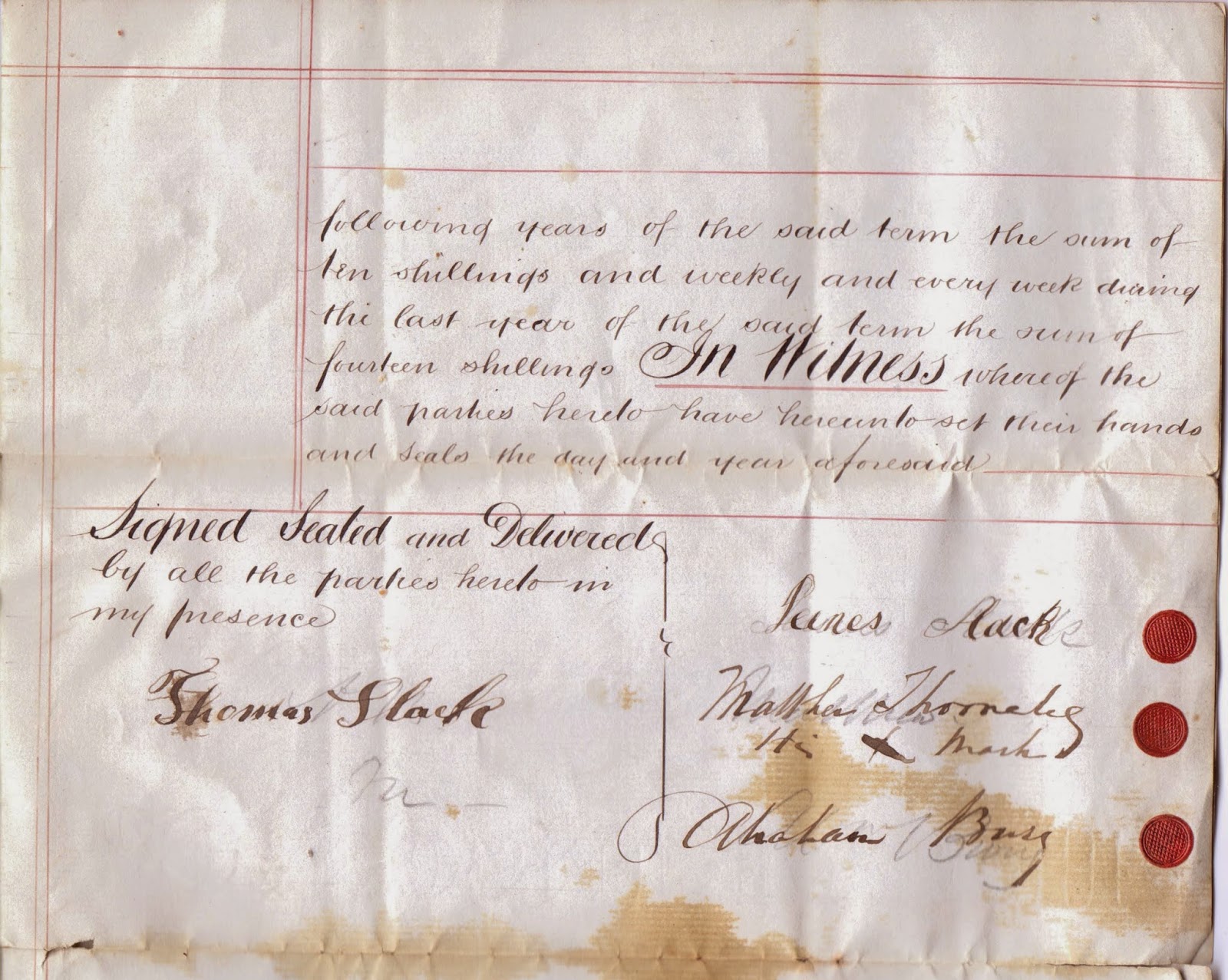
By making his mark at the bottom of this indenture 16-year-old Matthew Thornley of Sutton, near Macclesfield took the first step in what he hoped would be a successful career, becoming apprentice to one Abraham Bury, earthen-  and blackware manufacturer.

The deal was struck in February 1867 between Matthew and his father, beer house keeper James Slack, on the one part and Abraham on the other. Under the agreement Matthew and James swear that, until Matthew reaches the age of 21, he will:

his said master faithfully serve, …. his said master’s secrets keep, his lawful commands duly obey and execute … he shall do no damage to his said master nor suffer it to be done by others but to his power shall and will prevent the same … the goods of his said master he shall not waste, embezzle or destroy nor give or lend the same to any person or persons …. Neither shall he absent himself from the service of his master during all or any part of the said term without his said master’s consent. But in all things and upon all occasions shall and will behave and demean himself as a good and honest apprentice ought.

As well as this James promised to find and provide ‘good and sufficient meat, drink and lodgings and appropriate clothing of all sorts’ for Matthew, as well as ‘washing and medicine in case of sickness’, for the full term of the apprenticeship.

In return for all this Abraham pledged to ‘well and truly teach and instruct … the apprentice in the art and trade or business of an Earthenware Manufacturer and thrower of Earthen or Blackware’. He would pay Matthew ‘the sum of eight shillings weekly and every week’ for a year, and then ten shillings a week until the final year of the apprenticeship, when Matthew could look forward to fourteen shillings a week - about £30 today.

Before all this, the 1861 census shows that Matthew was living with his parents, James and Ann Slack on Byron’s Lane in Sutton. Again, James is given as a beer house keeper (the local would be the King’s Head but this isn’t stated), and Matthew is shown as a labourer at a silk works. He’s living with siblings James, Martha and William Thornley and Thomas and Mary Slack; so presumably this was Ann’s second marriage.

Matthew’s change of career came courtesey of one of his neighbours: Abraham Bury operated from premises further down Byron’s Lane, and was best known for tile and brick-making. A successful businessman, he became Mayor of Macclesfield in 1870-71, dying in 1873.

Matthew seems to have done well with his apprenticeship and he stayed in the trade. Come the 1881 census he is working as a potter, supporting a wife and two children on Old Mill Lane.

Thursday, 29 May 2014

The Shepley Spitfire


August 1940, and the Battle of Britain was entering its second month.

Among the pilots of 152 (Hyderabad) Squadron, defending the south coast - including the vitally important Portland naval base - was 22-year-old Douglas Shepley of Holmesfield, Derbyshire, who had married his fiancée only weeks before.

Douglas had already been credited with shooting down two German Me 109s, on 8th and 11th of August, when on the 12th 152 Squadron was sent to engage a German unit which had just bombed a radar station on the Isle of Wight. Unfortunately, two Spitfires never returned from the fray: P9456, piloted by Flight Lieutenant Withall, and Douglas’s K9999, both believed to have been shot down somewhere near the Needles.

For Douglas’s family this was the third devastating loss in less than a year. His sister Jeanne, a nurse in the First Aid Nursing Yeomanry, had been killed in October 1939 when the liner on which she was returning to England was sunk by a U boat near Gibraltar. Then, in May 1940, his elder brother, George Rex Shepley was shot down while dropping supplies to a garrison in Calais (for which he was posthumously awarded a Distinguished Flying Cross).

In the face of this latest tragedy Douglas’s mother, Emily, and his widow, Frances, decided to commemorate Douglas and all he meant to them by buying a Spitfire for the RAF in his name.

The idea of military vehicles and weapons being gifted to the Forces was not new. During the First World War the government had encouraged people to donate money towards the purchase of tanks, ambulances, guns and other equipment, a strategy which had proved very successful and attracted funds from around the world. Indeed, 152 Squadron itself was named after the Nizam of Hyderabad, whose donation was big enough to buy a fleet of DH9As.  (The then Indian Territories provided many such ‘gift squadrons’, their origins being reflected in their names and in the design of their badges; 152’s badge depicted the Nizam’s head-dress and the words ‘Faithful ally’.)

Having proved so successful earlier, the ‘gifting’ campaign was revived during the Second War, in particular by Lord Beaverbrook when he ran the newly created Ministry of Aircraft Production. A list drawn up by the Ministry costed a single-engine aircraft (usually a Spitfire but sometimes a Hurricane) at £5,700, rising to £20,000 for a twin- and £40,000 for a four-engined plane.

Having set their sights on a Spitfire, Emily and Frances set to work raising public awareness about Douglas, organising event after event – dances, tea parties, whist tournaments and jumble sales, installing collection boxes in theatres and pubs. The people of Derbyshire and neighbouring south Yorkshire somehow found money to help: Bolsover miners donated a percentage of their earnings to the fund and Sheffield ARP held collections at all their posts. In just 15 weeks the family had raised enough to buy the Shepley Spitfire.

The aircraft chosen was W3649, built by Vickers Armstrong in 1941. The name Shepley was painted in yellow below the cockpit. After its inauguration flight in August, a little over a year since Douglas’s death, it became part of 602 (City of Glasgow) Squadron, before serving with 303 (Polish) Squadron and then 485 (New Zealand) Squadron.  There, Shepley was requisitioned by Group Captain Francis Beamish, who used it as his personal plane, flown by him alone. Beamish survived several engagements in the Shepley Spitfire, but finally went down in the English Channel during a battle with 40 enemy aircraft on 28th March 1942.

As you would expect Douglas Shepley is commemorated on the RAF Memorial at Runnymede, in honour of those with no known graves, but a reminder of his and his family’s courage stands closer to home. When the brewer Hardy’s & Hanson’s built a new pub in Totley, near Holmesfield, it ran a competition to decide a name. Seymour Shepley, Douglas’s only surviving brother, nominated ‘The Shepley Spitfire’, and the brewery agreed. Seymour pulled the first pint at the pub commemorating his remarkable family in the winter of 1979.

Wednesday, 19 February 2014

Some new additions


Mow Cop
Photo: Tony Grist
We were sent a collection of newspaper clippings from the 1920s and 30s this week – someone who didn’t want them but didn’t think they should be thrown away (quite right too!). They’re mostly photographs, captioned by hand in writing that puts us to shame. (We think the writer was twelve at the time, to make things worse.) The photos are from right round Europe, but of most interest to us were a 1925 photo of Mow Cop folly captioned ‘…long famous as a landmark which it is now proposed to demolish’ (thank goodness that didn’t go ahead – we knew there was a long-running dispute over the land in the 1920s but didn’t realise demolition was ever on the cards); and a later one of the not-so-lucky Hooton Hall near Chester being demolished to make way for new houses. The collection also includes a number of politicians, including Mrs Mercer, the ‘first Lady Mayor of Birkenhead’ (1924/5) – hard to imagine anyone wanting to keep a picture of a modern-day MP in their scrapbook.


We’ve also added more local documents to our collection. We have several letters written by John Sneyd of the Staffordshire landowning family (Ralph Sneyd went to court in the 1850s to claim Mow Cop belonged to him; in the end he had to share ownership with Randle Wilbraham), and also more legal documents from the Challinor archive, detailing wills, indentures, loans and court cases, mostly from the Leek area. (This seems to have been a massive archive – we know quite a few people who have items from it and we believe the William Salt Library also has a large collection.) We also have some letters written from Liverpool in the 1790s: addressed to ‘Mr Cooke, of the Upper Pool near Hereford’ and ‘Mrs Edwards in the marketplace, Westbury’, they give you an idea of the size of the population at the time!

Our favourite, though, is a loan agreement made in 1766 between two Macclesfield men: Humphrey Goodwin, twister and button dyer, and Edward Bennett, hatbandmaker. Humphrey borrowed seventy-two pounds off Edward, around £8,500 today, to be repaid along with thirty-six pounds’ interest. We’ve found Humphrey in the records –  he was born in 1742 and christened at King Edward Street Presbyterian chapel; he married Hannah and had at least four daughters. Edward is proving more elusive so we’ll have to dig a bit deeper for him. What we really want to know, though, is what Humphrey did with the money …


Bond between Humphrey Goodwin and Edward Bennett, 1766 
(click to enlarge)


Thursday, 30 January 2014

Ferry 'cross the Mersey?


This tranquil scene, of what could be a father and son fishing, was sketched near Seacombe, Wirral in September 1811 – completely unrecognisable as the busy ferry port of today.  


Saturday, 21 December 2013

Happy Christmas!


Season’s greetings to everyone who’s let us loose on their family tree this year – we’ve had a great time researching some really interesting characters (and unearthing a few things perhaps best left undiscovered!), and look forward to meeting more of you in 2014.
 

Here’s how you would have spent your Christmas had you booked into the Crichton Hotel in Blackpool in 1937; and an example of a hand-painted card, sent to Miss Hilda Pickering of Macclesfield in 1921. (Click on image to enlarge.)


Thursday, 21 November 2013

Messines revisited

The story of the model village of Messines, as reported in our September blog, generated lots of interest, with people wanting to know how the model was rediscovered, and how it was ever lost in the first place.

Well, it was found through the detective work of two local historians – Richard Pursehouse and Lee Dent, members of the Chase Project military history group – and involved a host of volunteers, several archaeological units, Staffordshire County Council and researchers from across the globe. Plus, of course, a dog.

In 1920 the process of winding down the military camps of Cannock Chase was well underway, with reusable materials being salvaged and anything of value sent for auction. Remarkably, the Messines model didn’t seem to be considered important by the authorities, and it was ignored but luckily not destroyed. With grass and tree roots starting to encroach over the following months, local Cubs and Scouts tried to clean the model up, but when the huts surrounding it were torn down, it was completely exposed to the elements and began to deteriorate.

The future of the model seemed a little brighter come the 1930s, when Ernest Groucott, an ex-Grenadier Guardsman, undertook some renovation work. As an army driver he had been active in the area during the war and had seen the model being constructed. By 1932 he was giving guided tours of the model for a small fee and a restoration fund had been set up.

But this memento of the First War could only decline further as Britain faced the Second, and while local children played on it in the 1940s and 50s, by the 1960s it had almost completely disappeared from view.

And so it remained until 2007, when Richard Pursehouse picked up what he thought was a stick to throw for his dog – and discovered it was in fact concrete.  Richard and Lee had been researching the model since discussing it on a trip to the Somme Battlefields the previous year, and had tried to find the site. However, seeing the overgrown condition of the area, with not a glimpse of the model to be seen, they had more or less decided (like the Council) that it had gone. But now, a little scraping revealed patches of concrete around the gorse bushes … how much of the model remained?

In December 2007 Staffordshire County Council commissioned Birmingham Archaeology to assess the area identified by the Chase Project.  With the help of Dolores Ho of the National Army Museum in New Zealand, Richard and Lee continued to research the model, establishing the existence of the viewing area on three sides and that it had been built ‘under instructions from Lieutenant Colonel J.G. Roache for the use of the Regimental School to instruct officers and NCOs in Topography’. The Chase Project was able to gather an extensive dataset of maps, photographs and diaries to help archaeologists in their task.

Finally, in 2013, a full excavation of the model took place, with the site being declared to be of international as well as national significance.  The model was freed of scrub and dirt and a laser scan carried out so that an exact 3D replica can be built.

Unfortunately, although largely made of concrete the model is actually very fragile, and it was decided that it had to be re-covered to protect it from the elements and damage from burrowing animals. It was therefore covered with a breathable membrane, followed by a layer of sand, rabbit-proof netting and finally specially selected soil.

In this way the Messines model has been made safe for future generations as they contemplate some of the most momentous events in British history.
 
 
The model under construction.
Photo courtesy of the  National Army Museum New Zealand


Detail of German strongpoint north-east of Messines.
Photo courtesy of the Chase Project


Site of the model cleared prior to excavation.
Photo courtesy of the Chase Project


Anyone with any information on the model can contact the Chase Project at thechaseproject@gmail.com. The group is now also researching the Staffordshire Tank Banks of the First World War.

Monday, 28 October 2013

Enigma: changing the course of history

This week we remember Colin Grazier and Francis Fasson, killed on the night of 30 October 1942 during a mission that turned out to be one of the most important of the Second World War.

By 1942 the biggest threat to the Allies was from U-Boats, which the Germans used in ‘wolf packs’ to attack shipping and disrupt supply convoys. Finding and destroying enemy submarines had become a top priority for British forces, with Churchill later commenting that the only thing that really frightened him during the war was the U-Boat peril. So when, on 30 October, a U-Boat was identified in the Mediterranean Sea, travelling westwards some 70 miles off the coast of Egypt, several destroyers were sent to hunt it down.
 

The U-Boat – later found to be the U-559 – was located by HMS Petard, which immediately launched an attack. It took almost 10 hours of fighting for the sub to be forced to the surface, but it eventually appeared in the destroyer’s search lights at around 10.40 pm. The crew were evacuated and placed under arrest, but not before they had scuttled the sub. Knowing there could be important information inside, Petard’s Captain, Lt Commander Mark Thorton, asked for volunteers to search the damaged vessel.

Three men, who must by this time have been physically and mentally exhausted, accepted the risk: Lieutenant Francis Fasson of Jedburgh, Able Seaman Colin Grazier from Tamworth and, just 16 years of age, NAAFI canteen assistant Tommy Brown. Jumping naked into the freezing ocean, they swam to the stricken sub. Fasson and Grazier went inside to search for anything which might prove useful, managing to pass books and documents to Brown, who stayed on the conning tower. But the U-559 finally went under, and Fasson and Grazier were unable to escape in time.  

They had, however, changed the course of the war, because the books they passed to HMS Petard contained code keys to the now-famous German Enigma machine.

Enigma was used to encrypt Nazi messages and was so sophisticated that it was calculated the odds of breaking the code without a key were 150 million million million to one. It had been invented as a commercial device in 1923, but was picked up and refined by the German military, who believed its ciphers to be unbreakable. The Poles, with their knowledge of German engineering industry, had managed to re-create an Enigma machine as early as 1933, and had had some success in reading the Wehrmacht’s messages. But, come the Second World War, analysts were unable to break the stream of information sent by German forces on land, sea and air.

It took three weeks for the code books taken by HMS Petard to reach Bletchley Park, the secret base set up by the British government to intercept and crack enemy communications. But because of the books, analysts at Bletchley were finally able to break the codes used by the Germans to plan U-Boat attacks. The breakthrough occurred on 13 December 1942, and within an hour of the news being given to the submarine tracking unit the position of 15 U-Boats in the Atlantic had been revealed.

It has been said that the war was shorted by as much as two years because of the actions of Fasson, Grazier and Brown, with countless lives saved. Certainly the number of British vessels sunk in the months following the discovery was halved. However, with anything to do with Bletchley Park being subject to the Official Secrets Act, their heroism was not widely publicised and they did not get the recognition they so deserved.

Lieutenant Fasson and Colin Grazier were recommended for posthumous Victoria Crosses but, as they did not actually die ‘in the face of the enemy’, were instead awarded the George Cross. Tommy Brown was awarded the George Medal. Tragically, he was killed in a house fire in North Shields in 1945.

Today Tamworth has begun to acknowledge the debt owed to Colin Grazier and his comrades, and visitors to the town might find themselves on Grazier Avenue, Fasson Close, Brown Avenue, Bletchley Drive or Petard Close. A memorial to the men has also been built in Church Square, where a service is held on Colin Grazier Memorial Day.

Friday, 11 October 2013

Lightning never strikes twice …


Blooming in health and strength I gazed
Where my Creator’s lightning blazed
Nor for a moment thought that He
Had such a shaft prepared for me
He gave command – the thunder peal’d
And my eternal doom was sealed
 
This is the epitaph of Hugh Dolman, buried at the Baptist chapel in Melbourne, Derbyshire. As you might gather from the inscription, Hugh was killed by lightning – unusual enough, you might think. But what makes this even more extraordinary is that Hugh wasn’t the only victim; his neighbour William Bailey was also killed. The incident, which ‘created a great sensation in the neighbourhood’, was recorded by local historian and writer, John Joseph Briggs in his diary on 19 June 1846: 
 
about 6 O’clock this evening occurred a most aweful and distressing circumstance. At that time a heavy shower came on accompanied by thunder and lightening. Two persons in Melbourne named Willm Baily (hair dresser) and Hugh Dolman (Baker) were standing in the Potters Street talking together, Baily being in his own garden within a few yards of his own house, and Dolman in the street, just opposite to him. Just at that moment a loud peal of thunder was heard which in an instant [was] followed by a flash of vivid lightening, which stuck these poor men, and only a few minutes elapsed before they were both corpses.
Baily was taken across the road to his own house and expired immediately and the only mark visible upon him was a small place on one of his cheeks. Dolman lived a few minutes after being struck, his clothes seemed scorched or burnt with the fluid and [literally] kept dropping from him piecemeal as he was carried up the street. His hair, whiskers, & also his shoes were also burnt. The faces of both men went black and discoloured immediately. Just before Mr Bailey left the house his wife remarked ‘I would not go out something may happen to you’. He replied naturally enough as many a one has before him ‘Oh! One knows thunder and lightning … occurs a hundred times and nobody ever hurt by it’. 
 
Hugh and William were buried side by side two days later. The fire gods hadn’t finished with Melbourne yet, though, because the day after that (22 June) Briggs writes about another curious episode:
 
Fearful thunder storm. A ball of fire descended at a distance of not more than 50 yards from the spot [where Hugh and William were killed] and entering a house set fire to a quantity of paper in a room where a sick person was lying and then passing though the chamber entered a lower room. In its passage a portion of a scythe attached to the wall was melted and then [it entered] the chimney [carrying] with it the iron apparatus employed to hang kettles &c upon.  
 
This time there was a happier ending, with the house’s occupants escaping unharmed.

Monday, 16 September 2013

Model Messines in Staffordshire

Staffordshire has been in the news again, with archaeologists uncovering a find unique in Britain ­– a perfectly scaled down model of a Belgian town and its surroundings as it appeared during the First World War.

The model – of Messines and the countryside around it – covers some 40 square yards and was used as a training aid, to help British troops visualise what awaited them before they went to war. But it was actually built by the enemy – German prisoners of war – when they were held at Brocton Camp.

Messines occupied a strategically important position on the Western Front, and was captured by the New Zealand Rifle Brigade after ferocious fighting in 1917.  Over 50,000 men (from both sides) were killed, wounded or reported as missing in action. On retuning to Brocton, the New Zealanders planned out the Messines model and supervised construction. As well as houses, shops and churches, the infamous trenches, railway lines and roads are all laid out with incredible precision, right down to the contours of the land.

After the war, the model was kept as a memorial but eventually it became overgrown. Unfortunately, once fully uncovered it will only be open for viewing for a short time – it’s so fragile it will have to be re-covered to preserve it for future generations.


The model as it appeared in 1918


Tuesday, 27 August 2013

Plagued

With a good few centuries between us and it, most of us will admit to being fascinated by the plague.  Although outbreaks were common, most people think of ‘the Plague’ as the Great Plague of London of 1665. And that outbreak could have spread across the north of England, were it not for the courageous actions of the villagers of Eyam in Derbyshire.

It started at the end of August, when apprentice tailor George Viccars received some cloth from London. A few days after its arrival he fell ill, and within a week he was dead (killed, we now know, because of infected fleas living in the cloth). The family he lodged with, and then the Thorpe family next door, and then the Wragg family across the road, became horribly ill, and the villagers realised the plague was among them. A few left. But, under the guidance of rector, William Mompesson and the previous incumbent, Thomas Stanley, rather than risk spreading the disease, the vast majority of the villagers bravely decided to place themselves under quarantine.
As the plague took hold, neighbouring villagers left food and other supplies at boundary markers outside Eyam or at Mompesson’s well (as it is now called) above the village. Money was left in pools of vinegar in hollowed-out stones. To reduce the risk of cross-infection, families were tasked with the awful job of burying their own dead, either in their gardens or nearby fields. Elizabeth Hancock buried the bodies of her husband and six children within eight days of each other; she carried them half a mile away to Riley’s farm. It was also decided to hold church services outside, at a natural amphitheatre on the outskirts of the village called Cucklett Delf, rather than everyone crowding into the church.
Cucklett Delf was also where Emmott Sydall would meet her sweetheart Rowland Torre, who was from the nearby village of Stoney Middleton. They would call to each other across the rocks that separated them, until one day Emmott did not appear.
Some 14 months after the death of George Viccars, the outbreak eventually burnt itself out. Estimates of how many of the villagers died vary, but Eyam church has records of 273 victims. The population of Eyam was thought to be about 350.  William Mompesson lived, although his wife Catherine, who nursed the sick, did not. Elizabeth Hancock, too, survived. The first person to enter Eyam from outside in the wake of the plague was Rowland Torre, looking for Emmott. But she had succumbed to the disease six months earlier.
Eyam had paid a terrible price, but the villagers achieved their aim. The plague did not spread to surrounding towns and villages, and a major outbreak had been averted. Today, the last Sunday in August is ‘Plague Sunday’ in Eyam. An open-air service is held at Cucklett Delf to commemorate the sacrifice of the villagers.


Little Bess and a kind man’s grave
A few years before the events at Eyam, Congleton in Cheshire was suffering its own outbreak of a particularly virulent plague. First to be affected were the Laplove family, but the disease spread like wildfire. Mayor John Bradshaw (later to become infamous as the judge who sentenced King Charles I to death) banned all alehouses and lodging houses from taking in travellers from Derby and other areas suspected of being the source of the disease. A man was employed to shoot all dogs seen in the streets.
At the start, the sick were shut up in their own houses, guarded by wardens. Later, they were taken to specially built ‘pest-houses’, which were purged with pitch, tar and frankincense. They were each awarded twopence a day by the town for their care.
Heroine of this story is ‘Little Bess’ (also referred to in some quarters as ‘Lancashire Bess’, so presumably she was not a native of Congleton), who alone devotedly nursed the sick with no thought for her own safety.  The town accounts show Little Bess was given small amounts of money for ‘necessaries for the sick or the dead’ (including a bowl to hold liquorice and wine vinegar), and to support herself and her mother through the crisis.
The outbreak lasted two years and Congleton became so deserted that, it is recorded, grass grew in the streets. In spite of Little Bess’s efforts the Laplove household was almost completely wiped out – Astbury parish registers show that five of them were buried in two days. John Bradshaw’s accounts book shows that he sent money for ‘Laplove’s little girl in her weakness’, and his wife sent blankets. With the help of Little Bess, this child survived, but we do not know how many others did.
The parish register of Malpas, in the west of Cheshire, has a poignant entry regarding one man’s death at the hands of the plague. It reads: ‘Richard Dawson, being sick of the plague, and perceiving he must die, rose out of his bed and made his grave, and caused his nephew to cast straw into the grave, which was not far from the house, and went and laid down in the said grave, and caused clothes to be laid upon him, and so departed out of this world. This he did because he was a strong man, and heavier than his said nephew and a serving-wench were able to bury. He died about the 24th of August. This was I credibly told he did, 1625.’  
 
Some cures for the plague
The panic felt by our ancestors when they realised the plague had arrived must have been overwhelming. Powerless though they were against it, ‘cures’ abounded. Here are a couple ­– 
Take Walnuts, when the green Husk is on them, and before the shell is hardened underneath, put them, when bruised to steep in white Wine eight days: then with some Baum, Rue and Tops of Fetherfew and Wormwood a little bruised, put them in an Alembick and distil them: then when you drink an ounce and a half of water, which you may do, morning, noon and night, put it into some perfumed Comfits, and stir them well about till they are dissolved.
Take water of Scabious, Endive, Rue and red Roses, of each, four ounces, white Dittany, Tormentile, white Coral, Gentian and Bole Armoniack, with Terrfigillata – reduce those that are to be powdered separately; infuse them in the warm water in a glass vessel, and drink about an ounce at a time pretty warm, keeping the body warm after it. 
Margaret Blackwell, who came through the plague at Eyam, attributed her survival to the somewhat simpler remedy of drinking hot bacon fat.
 
 
'Plague cottages', Eyam. The end house was occupied by George Viccars, and was where the plague started. The house with the white front door, Rose Cottage, belonged to the Thorpe family. All nine died.
 
Graves of the Hancock family, at Riley's field.


Sunday, 11 August 2013

Guides at war


This picture from 1916 made us do a double take.

It’s actually a bike stretcher, used by the Guides – in this case the 1st Alderley Edge Company – to ferry people to and from hospital during the First World War.

The ‘Girl Scouts’, as they were called, had only been around a few years at this point, the movement having been inaugurated by Baden Powell in 1909. 1st Alderley – headed by a Miss Tipping – were one of the earliest groups to be established in Cheshire, along with Macclesfield (under Captain G.H. Owen), and Birkenhead and Rock Ferry (with Mary Crossfield, Ida New, Winifred Howard and Miss Raskin).  

As you would imagine, Guides worked tirelessly to help the war effort. As well as needlework, laundry work, cleaning and cooking, they  looked after children whose parents were abroad, typed documents, ran market gardens, and collected flax (used in making aeroplane wings) and herbs (for medicines). They  built trestle bridges, felled trees and, as shown in the photo below, collected salvage and recycled waste. They raised funds for convalescent homes, equipped and ran hospitals, and prepared and worked in houses for refugees.
 
 
And, come the Second World War, they did it all over again. From potato digging and hop picking to helping maintain the blackout, Guides more than lived up to their promise to ‘lend a hand’. Their fundraising really made a difference: in 1940 Guide Gift Week raised more than £48,000, double the amount earmarked  to provide two air ambulances and a lifeboat (Cheshire’s contribution of over £1,000 was among the highest in the country). The two ambulances were handed over to the RAF and the lifeboat arrived just in time to take part in the evacuation of Dunkirk – it was named Guide of Dunkirk.
 
After the war, it was hoped a fledgling Guide movement in Germany would begin to heal old wounds, and German Guides from the British Zone visited Cheshire. Local reports at the time say they were ‘impressed by the warmth of their welcome and by the kindness and courtesy that the English people showed’. So did Guides also help in the long process of building peace.


Friday, 26 July 2013

A family affair? The curious case of Perkin v. Birchenough


The Queen and Hezekiah Perkin v. John Birchenough was heard at Stafford Winter Assizes on 16 December 1865. At first sight the case seems to be a straightforward robbery – Birchenough was a petty criminal who had already served time in Derby gaol for attempted larceny – but a little digging has revealed there may well be more to matters than first meets the eye.  

The story starts on 28 September 1865, when Hezekiah Perkin, keeper of an eatinghouse in Spout Street (now St Edward Street), Leek, rose at 6 a.m. Going downstairs he found the back door closed but unbolted – he was sure he had left it bolted the previous night.

Just then he heard his wife calling from upstairs. On getting up Louisa Perkin had discovered that her clothes were not where she had left them the previous night: ‘I picked them off the floor and thought they felt light – I examined my pocket and found that my purse and money were gone.’ The purse contained two watchkeys, a half-sovereign and some silver, and there were a further five shillings wrapped in paper in a pocket.

Hezekiah investigated further and found that the trap door from the coal cellar into the street had been unfastened and that ‘a candle had been used about the house during the night’. A candlestick and a partly burned candle, usually left on the chimney piece, were on a table near the back door and a partly burnt match (‘we generally cut them off with scissors’) was on the cellar steps.

The Perkins took an inventory and discovered that two silver watches, one with a gold Albert chain and key,  and the other (a new one) with a silver guard and gold seal, were missing. Going into the shop, Hezekiah discovered that a bag containing ‘£1.15.0 in money and 5/- in copper’ was also missing off the counter, ‘the last shilling of which I had counted and placed there the previous night’.

Immediately the couple thought of John Birchenough, who lived ‘in the immediate neighbourhood and had been formerly in the habit of going to the house’. Louisa reported the break-in to the police. However, they then seem to take matters into their own hands. A week or so later, on 7 October, Louisa went to see one of John Birchenough’s friends, William Flanagan, silk twister and, as we shall see, dab hand at ‘toss’. Louisa found Flanagan in the Bull’s Head in Spout Street and told him that, if Birchenough were to return the missing items, they would not press charges. As a further sweetener, she let it be known she would give 10 shillings for the return of the watches. Their conversation was heard by Elizabeth Boothby, wife of the landlord.

William Flanagan’s statement to the police (by this time he was under commitment for three months on a charge of assault, so he didn’t have far to go) confirmed that he had spoken to Birchenough after meeting with Louisa. Perhaps not surprisingly, Birchenough had denied any knowledge of the missing items. Flanagan told him ‘if he had them we could put them right and have no further bother’. He also told police he had won nineteen shillings from Birchenough gambling at toss a couple of days earlier, first in the Talbot Inn and then behind Alsop’s shade. (A shade was the local name for the sheds where threads were twisted.) Birchenough had paid up with a half-sovereign and silver which he took from a purse – perhaps not the best move in the circumstances.

Later on, in the evening of 7 October, Mrs Boothby sent for John Birchenough, who by this time must surely have been sick of the whole saga. ‘He came to my house,’ she told police. ‘I told him Flanagan was locked up and asked the prisoner to give me Mrs Perkin’s watches. … I said if he did not wish  to give them to Mrs Perkin he might leave them in my hands and I would see she had them back. [He] immediately went away and in a few minutes returned and gave me the watches standing at my parlour door.’

It would seem that things had been pretty much sorted out without any involvement from the police, but on 9 October John Birchenough was arrested at his house in Jacob’s Alley by Superintendent Thomas Woollaston. Birchenough denied any knowledge of the burglary or watches but was charged that he did ‘feloniously and burglariously break and enter the dwellinghouse of Hezekiah Perkin’. The prosecution brief notes that if the burglary charge did not stick then receiving stolen goods could certainly be proved. This wasn’t necessary, though. John Birchenough was found guilty and sentenced to six months with hard labour.

So ends the story. But we were intrigued to discover that after his release John Birchenough moved from Leek to Woolstanton and began to call himself John Perkin. A brief look at the records revealed that Birchenough was actually John’s mother’s name and they both lived with a Joseph Clowes Perkin; Hezekiah Perkin had a brother of that name. So it seems likely that Hezekiah Perkin and John Birchenough were actually related, or at least known to one another. In fact they may well have been uncle and nephew. 

Which raises a whole host of questions. Why didn’t the Perkins tell the police John was a relative? Hezekiah’s statement merely says: ‘I know the prisoner. He lives in a yard behind my house.’ Did the police know but not record the fact?  Hezekiah and Louisa seemed to go to some lengths to sort the matter out themselves – because Birchenough was family? In which case, why go to the police at all?

Or is the whole thing a coincidence of names, a genealogist’s nightmare?  If anyone has researched this family, please let us know!


Monday, 15 July 2013

The fasting woman of Tutbury

In 1808 Robert Taylor, a surgeon living in Tutbury, Staffordshire, made an astonishing claim: that local woman Ann Moore had survived without food or water for 13 days. The report he published appeared to vindicate Ann’s claims that she had passed years with no nourishment. Her fame as the ‘fasting woman of Tutbury’ was assured, and became one of the cause célèbres of the age.

But was it for real?

Ann’s story starts at Rosliston in the south of Derbyshire, where she was born Ann Peg in 1761. Her parents were poor and Ann went into service at a young age. At 27 she married James Moore, a labourer. But James left her, and she and her children (reputedly fathered by the master of the house) eventually made their way to Tutbury.

Perhaps because in her poverty she did actually manage to survive on very little food, once at Tutbury Ann began to make her claims that she could survive without any food. Although most were sceptical, some in the village were prepared to swear they had never seen her eat or drink. Talk grew, and Ann agreed to be placed under surveillance to prove her case. So, in September 1808 she was taken to the house of Tutbury’s grocer, Mr Jackson. The fast was supervised by Robert Taylor, with groups of villagers coming and going as they pleased, so Ann was never alone.

For three days Ann took a little water but for the next 13 she had nothing: hence Taylor’s report backing her contention. Taylor speculated that, with the window to her room always being open, she was somehow imbibing nourishment from the hydrogen in the air. With such ‘proof’ to support her, Ann’s fame spread across England and beyond; pamphlets were published about her and she was used by the prophesier Joanna Southcott to promote her cause.  

By now Ann was receiving hundreds of visitors – many of whom left a ‘little gift’ for her and her children.  It is estimated she had made £250 by 1809 and up to £500 thereafter.

Not everyone, however, was convinced. For a religious woman (a Bible always lay open on her bed and she assumed an air of piety, discussing religious matters with her visitors), Ann was subject to surprising outbursts of ‘such virulent language as would fully evince the absence of all religious principle in her’. Then there was her questionable morality – her illegitimate children and the fact she was living openly with a man while still technically married to James Moore. Her explanation for her strange gift was also inconsistent: first she claimed it was a result of her washing the cloths used to bind a boy’s ulcerous wounds; then she said it was due to ‘extreme want’; and then that it occurred gradually, that she took less and less food, then liquid only, and then nothing at all.

In April 1813, with Ann still claiming to have had no sustenance in all that time, a committee headed by Sir Oswald Mosley and including doctors, ministers and magistrates from the surrounding towns, decided that she should be placed under a second watch – and this time for a month. Ann was placed in a new bed with a weighing machine attached and the mattress was stripped and filled with chaff.

After seven days it was announced that she had taken no nourishment, and Ann looked set to prove the doubters wrong once more. But on the eighth day she appeared distressed and said she was too ill to continue. Her weight loss was noticeable and her pulse erratic. Worried she would die, Mosley halted the watch and called for Ann’s daughter, after which she started to recover. The results of the trial were published in a second report, this time by the Rev. Legh Richmond.

After the failed test Ann initially stuck to her story that she had taken no food or drink for the previous six years. However, she then made a full confession that: ‘I Ann Moore, of Tutbury, humbly asking the pardon of all persons whom I have attempted to deceive and impose upon, and above all with the most unfeigned sorrow and contrition, imploring the divine mercy and forgiveness of that God, whom I have greatly offended, do most solemnly declare, that I have occasionally taken sustenance for the last six years.’

Ann had to leave Tutbury to escape the wrath of her victims, and she is said to have died soon afterwards. Most believed that some food must have been smuggled into her in the first watch, either by her daughter or another collaborator amongst the villagers. However, it would seem that she could have received only minimal sustenance and she must truly have been able to survive on very little food.

We will never know whether Ann devised the entire scheme as a money-making scam, or whether it was just idle boasting around her village that grew completely beyond her control.
 
Engraving of Ann by Anthony Cardon, 1812

Frontispiece of second report


Sunday, 30 June 2013

Heading to the Forest: The English Gretna Green

The path of true love for many might have been the quickest route to the Scottish border, angry relatives in tow, but for the lovelorn couples of the Peak there was a more local, slightly less onerous, alternative.

A legal anomaly meant that the Church of St Charles, King and Martyr in the village of Peak Forest could issue its own marriage licences, free of the rules of the Established Church – and parental consent.

Peak Forest came into being in the early 1500s, when an enclosed park for the King’s deer was created between Tideswell and Chapel-en-le-Frith. A house, known as ‘The Chamber of the Forest’, was built for the park steward, and became the administrative nub of the newly forming village. St Charles, King and Martyr was built in 1657 by Christiana, Countess of Devonshire, and, as it stood on land belonging to the Royal Forest, lay outside the jurisdiction of the Church. Its vicar – officially, and rather wonderfully, called the Principal Officer and Judge in Spiritualities in the Peculiar Court of Peak Forest – could perform marriages at any time, for people who did not necessarily reside in the parish, without having to read the banns first. 

One of the Peak District’s most intriguing tales concerns a couple who, in 1758, were eloping to Peak Forest. Clara and Allan had made it as far as Castleton, when they stopped at a local inn. Later, as they rode through lonely Winnat’s Pass, they were robbed and murdered by a group of men who had also been in the pub and noticed  the money-bag they were carrying. The lovers’ bodies were never found but divine justice was theirs: of their five assailants one broke his neck (also in the Winnat’s Pass), a second was crushed by falling stones, the third committed suicide and the fourth died mad; the fifth died young, making a death-bed confession to the crime.

Clara’s red leather saddle was recovered and can still be seen in the shop at Speedwell Cavern. It is said the ghosts of the couple haunt Winnat’s Pass to this day.

For another 50 or so years after Clara and Allan made their ill-fated bid to marry, couples headed to Peak Forest for a ‘foreign marriage’ to be performed. But in 1804 an Act of Parliament brought St Charles, King and Martyr into line with the rest of the Church of England.  The register notes: ‘Here endeth the list of persons who came from different parishes in England and were married at Peak Forest. This was a great privelege for the Minister, but being productive of bad consequences, was put an end to by an Act of Parliament.’

And so ended one of the most romantic traditions of the Peak. The original St Charles, King and Martyr was demolished in 1876 when the 7th Duke of Devonshire decided to replace it with the present building, which stands about 20 yards from the old site. Stone from the first church was, however, used in the construction of new reading rooms in the village, so at least something of its spirit remains.
 
 
St Charles, King and Martyr; photo by Poliphilo
 
                                           Winnat's Pass, early 20th century